The Man Who Would Be Sherlock by Christopher Sandford
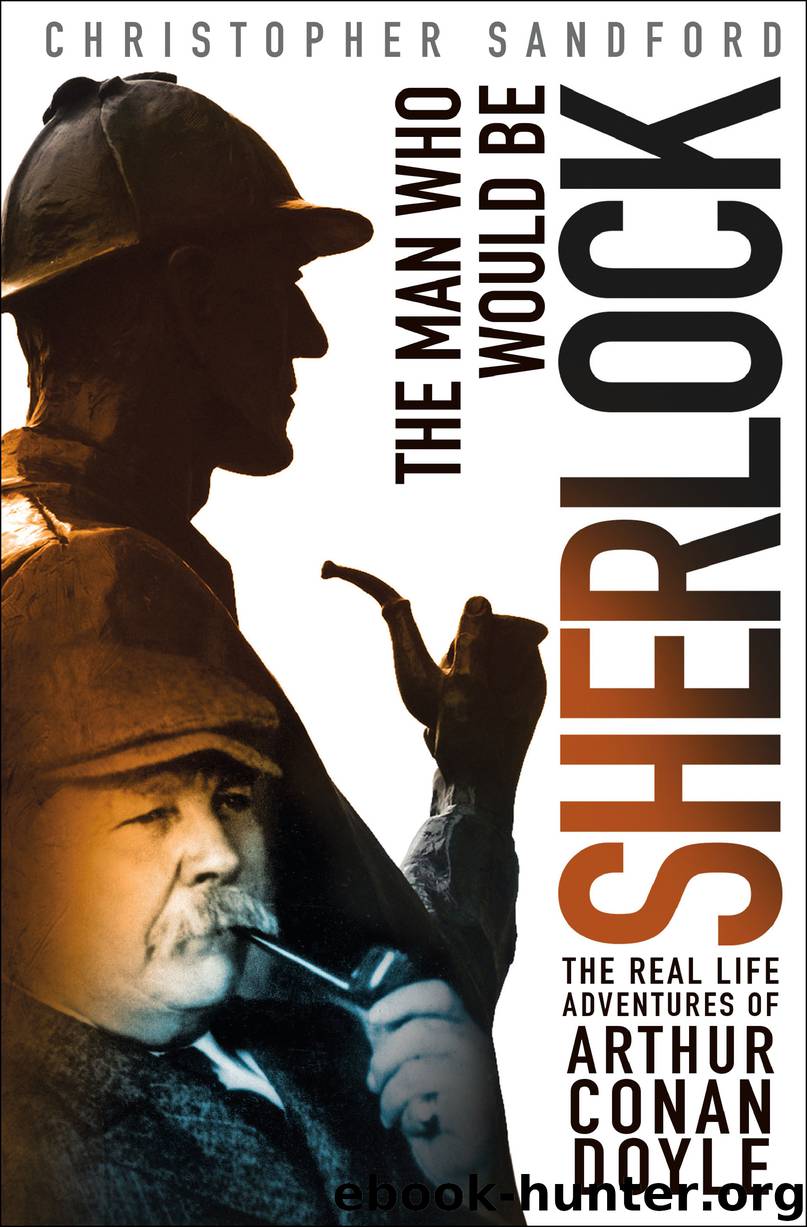
Author:Christopher Sandford
Language: eng
Format: epub
Publisher: St. Martin's Press
We should desire to point out that the prisoner had for many years been exposed to severe strain during his honourable career of public service, that he had endured several tropical fevers, and that he had experienced the worry of two investigations which were of a peculiarly nerve-trying character.
Acknowledging receipt of Doyle’s petition, the Home Secretary Herbert Samuel replied:
As you are good enough to say that you desire to leave it to the discretion of His Majesty’s Government whether the appeal should be made public, I am writing to inform you that the Government prefer that it should not.
This was perhaps to underestimate the author’s obstinacy and resilience once embarked on a crusade for justice. Doyle soon rallied influential friends such as John Galsworthy, Arnold Bennett, William Butler Yeats, John Masefield and G.K. Chesterton, among others, to Casement’s cause, although he seems to have parted from the more broadly pacifist Edmund Morel, whose tactics he called ‘a policy of murder’. (George Bernard Shaw characteristically circulated his own rival petition.)
On 2 July, Doyle wrote to his fellow campaigner, the literary journalist Clement Shorter. ‘Personally, I believe Casement’s mind was unhinged,’ he reasoned:
His honourable nature would in a normal condition have revolted from such an action … I am entirely against his execution. I am sure it is wrong. It seems to me that the line to go upon is to absolutely acknowledge his guilt & the justice of his sentence and at the same time urge the political wisdom of magnanimity. It should be signed so far as possible by men who have shown no possible sympathy for Germany or pacific leanings.
On 13 July:
Dear Shorter, The summons to the Foreign Office proved to be about Casement. They told me that his record for sexual offences was bad and had a diary of his as proof of it. I had of course heard this before, but as no possible sexual offence could be as bad as suborning soldiers from their duty, I was not diverted from my purpose. None the less it is of course very sad, and an additional sign of mental disorder.
The record shows that Doyle again wrote to the authorities on 25 July, at which point he believed there were still ‘some weeks’ before the date of Casement’s execution. But the prisoner’s ‘black diaries’, as they became known, soon countered any appeals for clemency. Circulated in parliament and the press, no one who read them, according to the News of the World, would ‘ever mention Casement’s name again without loathing and contempt’. He was hung at Pentonville Jail on 3 August 1916.
In his autobiography, Doyle was both generous and not entirely free of authorial pride on the subject. He wrote:
Casement, whom I shall always regard as a fine man afflicted with mania, has met his tragic end, and Morel’s views upon the war have destroyed the feelings which I had for him. But I shall always maintain that they both did noble work in championing the wrongs of those
Download
This site does not store any files on its server. We only index and link to content provided by other sites. Please contact the content providers to delete copyright contents if any and email us, we'll remove relevant links or contents immediately.
4 3 2 1: A Novel by Paul Auster(12352)
The handmaid's tale by Margaret Atwood(7725)
Giovanni's Room by James Baldwin(7293)
Asking the Right Questions: A Guide to Critical Thinking by M. Neil Browne & Stuart M. Keeley(5734)
Big Magic: Creative Living Beyond Fear by Elizabeth Gilbert(5721)
Ego Is the Enemy by Ryan Holiday(5383)
The Body: A Guide for Occupants by Bill Bryson(5062)
On Writing A Memoir of the Craft by Stephen King(4909)
Ken Follett - World without end by Ken Follett(4701)
Adulting by Kelly Williams Brown(4549)
Bluets by Maggie Nelson(4533)
Eat That Frog! by Brian Tracy(4497)
Guilty Pleasures by Laurell K Hamilton(4416)
The Poetry of Pablo Neruda by Pablo Neruda(4077)
Alive: The Story of the Andes Survivors by Piers Paul Read(4009)
White Noise - A Novel by Don DeLillo(3987)
Fingerprints of the Gods by Graham Hancock(3974)
The Book of Joy by Dalai Lama(3957)
The Bookshop by Penelope Fitzgerald(3826)
